
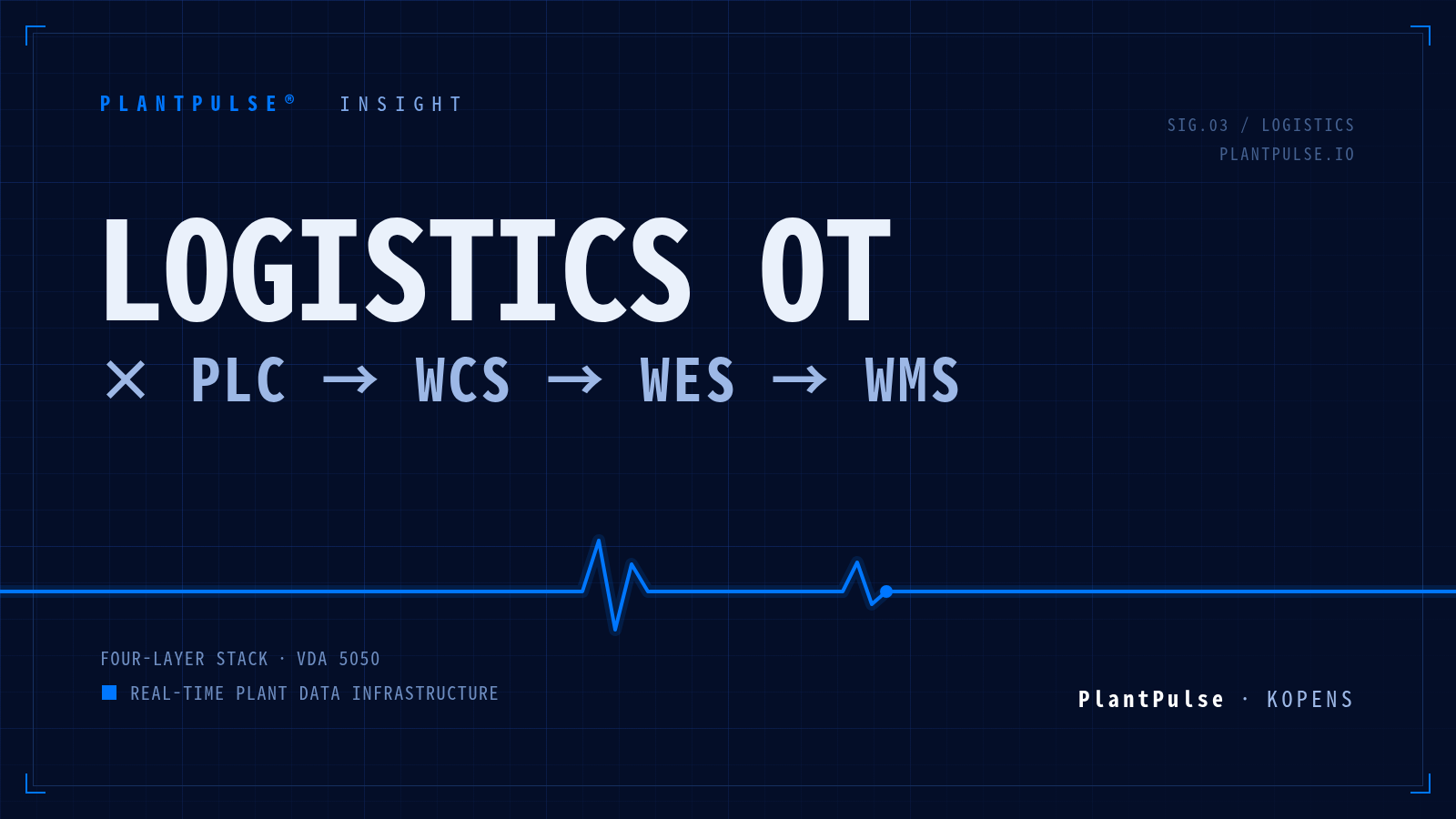
Factory OT architecture has been codified by decades of standards — ISA-95 and the Purdue model — but logistics centers are a different story. Conveyors, sorters, automated storage systems, and AMRs run under one roof on different controllers and protocols, and on top of them sit three-letter acronyms — WMS, WCS, WES — that mean something different from vendor to vendor. Here is the layered structure to get right when designing logistics center OT, along with best practices proven in the field.
Reading the Logistics Center OT Stack in Four Layers
- Equipment layer (PLCs, drives, sensors) — the PLCs that control conveyor drive units and sorter diverters; barcode scanners, vision, and photoelectric sensors; inverters. Cycles run in milliseconds, and a stop at this layer means a line stop.
- Control layer (WCS) — the warehouse control system that ties equipment together into flows. Carrier tracking, merge and divert control, and chute assignment happen here.
- Execution layer (WES) — orchestration that breaks order waves into tasks and distributes them to equipment and people. As the real-time decision layer between WCS and WMS, it is the layer growing fastest in recent architectures.
- Management layer (WMS, ERP, TMS) — inventory, orders, transportation. It works at transaction granularity, and its real-time requirements are comparatively low.
When one layer starts doing another layer's job — the WMS directly controlling conveyors, or order logic creeping into the PLC — that architecture will inevitably collapse at the scaling stage. Separation of responsibilities by layer is the first principle.
Five Best Practices
- Cut point-to-point integration — wiring WMS, WCS, and equipment together with 1:1 interfaces makes integration cost grow quadratically with every new piece of equipment. First establish a structure where "everyone reads the same data at the same address," built on a messaging-broker-based event bus and a Unified Namespace (UNS).
- Standardize on protocols — OPC UA for new equipment, MQTT (Sparkplug B) for telemetry, and legacy PLCs accommodated by converting Modbus and the like at a gateway. Integrating AMR fleets without vendor lock-in via the VDA 5050 standard is the global trend.
- Build throughput metrics directly from OT — sorts per hour, chute jams, merge queues, and equipment availability must be computed in real time from equipment signals, not from WMS reports, to be of any use in peak season. A report that arrives two hours before the outbound cutoff is already too late.
- Start predictive maintenance with the drive components — most logistics center downtime comes from drive components such as motors, rollers, and belts. Baseline learning on current and vibration time series alone can catch the precursors of bearing wear and belt slip.
- Segment networks with IEC 62443 zones and conduits — place a DMZ between the equipment network and the office network, keep WCS and WES in the OT zone, and restrict remote vendor access to a single auditable path. Because logistics centers run around the clock, "patch it later" does not work — which makes perimeter defense all the more important.
Conclusion
The difficulty of logistics center OT comes not from the equipment but from the integration. Respect each layer's responsibilities, and collect data once — over standard protocols and an event bus — so that everyone can use it: that is the structure that protects throughput and availability at the same time. It is also why PlantPulse® binds gateway ingestion (Edge), time-series storage and asset models (Platform), drive-component anomaly detection (AI), and shop-floor screens (Studio) into a single stack at logistics sites — collect the data once, and let every layer see the same picture.